The Unexpected Metric of AI Success
An Interview with Jeff Gothelf

Human values have always been a fascination of mine.
From why, to what, to how, I find myself drawn to exploring the ways in which our values influence our actions, both on the human and AI level. Lately though I’ve found my curiosity captured by one question in particular:
How can we use our values to drive desired business impact in AI?
We as people will naturally (try) to live our lives in alignment with our values. In doing so, we find a sense of purpose and fulfillment, which then influences us to continue to use our values as key decision-making factors in our lives. In other words, we use our values to create desired outcomes in life.
It may be obvious how our values influence our personal lives, but it is less so when it comes to our professional lives. Although we do not tend to discuss how different values will impact our careers, there is no denying that these principles are powerful influencers silently driving our critical decisions from behind the scenes.
And I sure do love bringing the kinds of things everyone experiences but no one talks about into the spotlight of discussion.
So, one of the many facets I’ll be introducing to this newsletter is an interview series in which I sit down with some of today’s leading thinkers, doers, and dreamers in AI to understand what values are driving their business impact in AI and why.
And lucky you, today I have the very first of these interviews to share.
TL;DR - Watch the interview with Jeff Gothelf here

The following is one-part summary of Jeff’s interview and one-part my reflections on the conversation. To listen to the full discussion, check out the recording here.
Who is Jeff Gothelf?
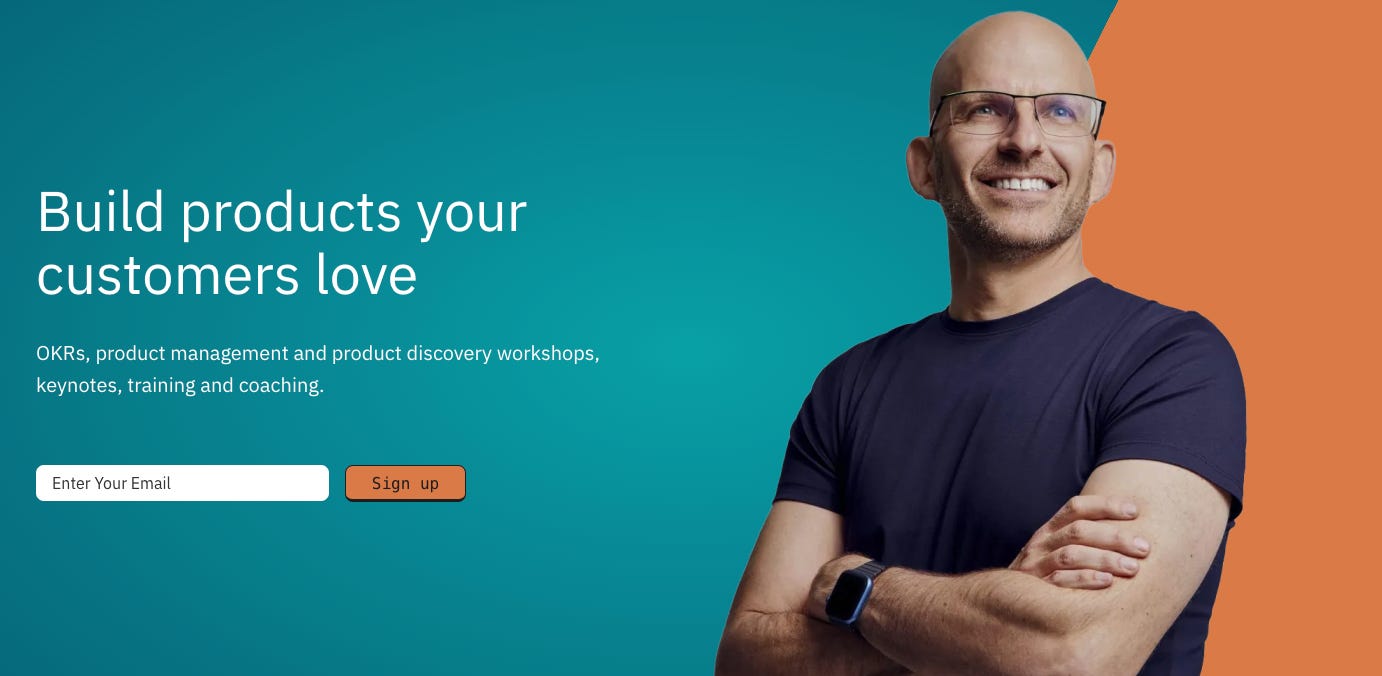
Jeff is a leading voice and thought leader on customer centric product development. He helps organizations build better products and executives build the cultures that build better products. He is the co-author of the award-winning book Lean UX (now in it’s 3rd edition) and the Harvard Business Review Press book Sense & Respond. In 2020 he published the critically acclaimed book, Forever Employable.
Starting off as a software designer then product manager and finally entrepreneur, Jeff now works as a keynote speaker, trainer, coach, and board advisor helping companies put the customer in the century of every decision.
Most recently Jeff co-authored Who Does What By How Much?, his 5th book and 3rd with co-author Josh Seiden. This new book is the how-to guide for implementing Objectives and Key Results (OKRs) in every organization.
What is Jeff’s driving value?
The other week, in response to the release of his newest book, someone on LinkedIn challenged Jeff about how he could possibly know so much about so many things that were seemingly unconnected. Jeff immediately had a simple yet elegant answer, pin pointing the driving value beneath the many facets of his career:
Everything Jeff does is focused on putting the customer at the center.
Jeff noticed early on in his career that when it comes to discussing business goals, the customer was generally left out of the conversation. Instead of looking to understand the needs of the customer, the benchmark of success tended more towards “did you make the stuff, and did we make the money?”. This put the focus on the actions and outcomes of basic business functions, and as Jeff has been emphasizing throughout the entire body of his work, this focus misses out on the bigger picture value beneath it all - the humans we built the business to serve in the first place.
Shifting this value of customer-centricity to the context of AI, Jeff stresses that the current metrics of ‘revenue and shipping stuff’ fail to capture the real indicators of success for an AI product. Instead of looking at AI as just another way for us to meet the needs of our customers, we have been caught up in the race of the shiny object syndrome, endlessly shipping new AI ‘stuff’ in the hopes of driving revenue.
When it feels like the world is caught up in trying to implement the latest and greatest AI development, Jeff argues that the true leaders will instead look to understand the continuously shifting customer consumption and behavior patterns.
In other words, leaders will drive AI success by placing customers back at the center.
What does Jeff’s value look like in action?
Let’s take a look at how Jeff practices what he preaches in his own adoption of AI for his business.
Since the beginning, Jeff has emphasized generosity when it comes to sharing his expertise and thinking with his community. When he first started, he would make time to meet with anyone interested in learning more about his methods. However, as his career progressed, time quickly became a limiting factor, which has pushed Jeff to look into new and innovative ways to generously share with his community.
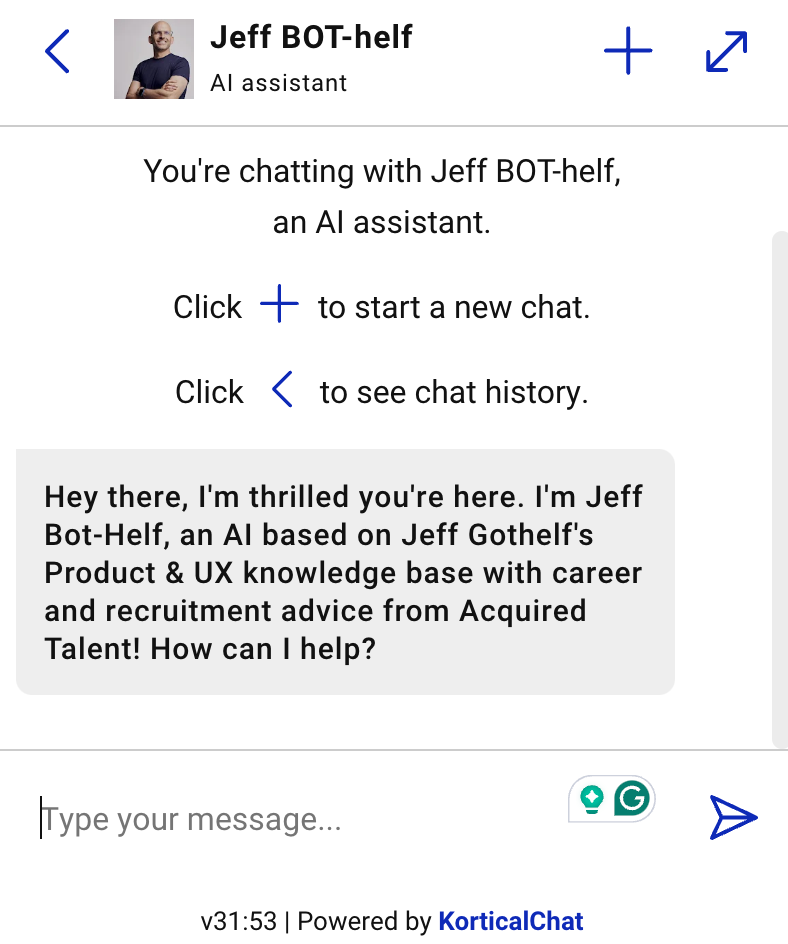
Enter stage left: Artificial Intelligence. Or, more specifically, Jeff BOT-helf.
Harnessing the power of generative AI chatbots, Jeff took the entire body of his work and created Jeff BOT-helf, a chat feature now live on his website that enables a user to interact with Jeff’s expertise and thinking through conversation. Essentially, Jeff packaged up his information so that his community could ‘pick his brains’.
Now, I know what you’re thinking. Everyone is deploying chatbots, what makes Jeff’s so special?
What stands out about Jeff BOT-helf has nothing to do with the technology, and everything to do to with the underlying value driving the entire approach.
You see, Jeff (the human) didn’t deploy Jeff (the bot) because everyone else was doing it and he was afraid of being left behind. Instead, Jeff looked at the needs of the customer (his community) and saw the potential for how he could use AI to better meet those needs. Taking things one step further, Jeff and his team defined the bot’s metrics of success as whether or not users were asking good questions, if there is repeat usage, and if customers are getting clear value out of it - not by how cool or shiny having a personal chatbot looked.
In other words, Jeff built his AI adoption strategy on his core value: putting the customer at the center.
How can you bring Jeff’s value to life in your own work?
So you like the idea of Jeff’s value of putting the customer at the center, but how do you bring this to life in your own work?
Jeff’s tip on making the change to customer-centric AI: Change the questions you’re asking your team.
Typically at the start to a new AI project we begin by asking questions like what are we going to make, when will it get gone, and how much will it cost? These kinds of questions direct the focus onto business and development functions, leaving little to no space for any consideration of the customer. Instead of asking about the details of the project, Jeff advises to start by asking the core question:
What will people be doing differently when we succeed?
Once you have a clear grasp on what an answer to this question might be, then you go and try to figure out how to best solve for that human behavior change. In other words, you understand what kind of impact you want to bring to your customers, and only after you have this clarity do you bring AI into the conversation.
Jeff Gothelf’s definition of good tech
“Good tech is something that solves a meaningful problem for me (or for other humans) in a meaningful way. It means you have gone out into the world, identified a real problem to solve that real people have, you came up with a solution that solves the problem and solves it better than current solutions and you’ve deployed it in such a way that the people you made it for actually use it.”
P.S. If you’re using the Values Canvas methodology, Jeff’s customer-centric AI approach aligns perfectly with the Domain element *hint hint*.
Say hello to the human
Experience Jeff BOT-helf yourself at jeffgothelf.com, follow Jeff’s work on LinkedIn, or check out his latest book at okr-book.com.