

Finding purpose in the AI-enabled workplace
An Interview with Max Malterer, Author of The Human Relief Project

When was the last time you tinkered in your work?
And I don’t mean flipping through all your open LLM chats, downloading a new app, and abandoning yet another project planning board after thirty minutes of color coding kind-of-tinkering.
I mean the true roll-up-your-sleeves, stumble through something entirely new in a zero-stakes environment, and fumble about with no objective other than figuring out what makes something tick kind-of-tinkering.
Lately it feels like the pressure to adopt AI into our work has come at the price of our ability to tinker. Instead of allowing our selves time to explore new tools on a small scale in controlled environments, we are expected to generate immediate value on a global stage.
But what would happen if we stopped trying to crack that elusive AI cheat code and allowed ourselves once again to playfully tinker through what works and doesn’t about this tech for us?
Want the full conversation? Watch Max’s interview here.
The following is one-part summary of Max’s interview, one-part my reflections on the conversation. To listen to the full discussion, check out the recording here.
Who is Max Malterer?
Strategic doer by day, novelist by night, Max Malterer is a man of many hats.
Balancing between the big picture and the nitty gritty, Max works in strategy operations for a Berlin startup as his day job where his love of systems and technology strings the red thread through his career to date.
A few years back though Max took a little career break and decided he wanted to fill his time with a creative project. Having always dreamt of writing a book, he took the opportunity to dive in and try on the writing creative pursuit for size.
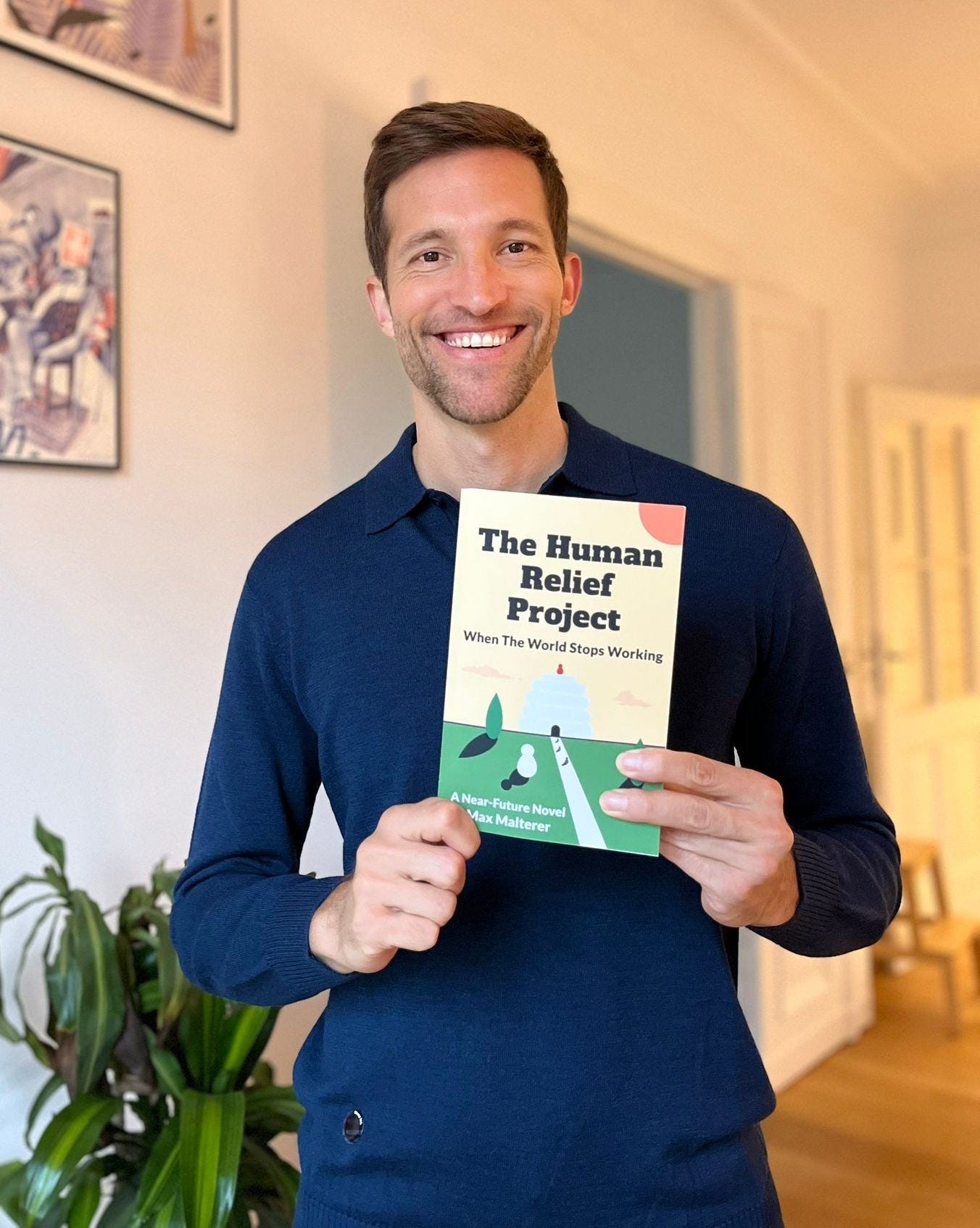
The result? His first book, The Human Relief Project, a fictional novel that explores what the world would look like if AI were to “relieve” all humans from their day jobs.
What is Max’s driving value in AI?
As authors, we are often driven to writing out of the need for exploration of some idea or another that we just can’t seem to shake. In Max’s case, the origin of his career break that eventually led to the book had been years of wondering how he could find more purpose in his work. After using every possible reflection framework he could find, he figured why not try the whole thing from a different angle.
Working in tech and surrounded by conversations of how AI is promising to change the face of the modern-day workplace, The Human Relief Project provided him the perfect avenue to explore his value of finding purpose and meaning.
The many paths to purpose
In the book, the reader is taken on a journey as each of Max’s characters are slowly but surely “relieved” of their work by AI. Some of Max’s characters are truly happy with the development, as they find time to explore new hobbies and interests. Others are sadden by the change, finding that their job had held more meaning than just a paycheck for them. Still others are torn, and take to trading on the “grey market” where there is still a secret demand for work done by humans.
No matter the character or their arch, Max found himself fascinated by the experience of looking into what gives people purpose and meaning in not only work, but life in general. In the end, Max’s search for purpose did not result in a end-all-be-all single source, but instead with the realization that the beautiful thing about finding purpose is that it looks different for everyone.
In his own words, Max found that “there are many other ways to find purpose in life, right? And I think it gave me a lot of appreciation and empathy for other ways of finding purpose at work.”
How do you find purpose in your work?
Now let’s bring this conversation into the workplace, and imagine having to sit down with your team to discuss how AI is going to change things. It’s not necessarily about whether AI will take over someone’s job, but rather as AI takes over certain aspects of work, how do you ensure the part that brings people purpose remains within human agency?
Not so easy a discussion to start, now is it?
As Max learned from his experience of exploring this idea through his novel, the best place to begin is with the simple question of “what brings you energy?”. Not profit, not productivity, not efficiency, but energy.
Because the key here is that a sense of purpose inevitably brings you energy, and when you have energy, you naturally create deeper, stronger, and higher quality work.
The objective of AI in the workplace is not about AI improving the quality of your work. It’s about you improving your own quality of work through intentionally using AI to enable you to do more of what brings you that purposeful energy.
Max Malterer’s definition of Good Tech
“Good technology enhances our capacity for human agency, both individually and collectively. And so maybe it’s a bit oversimplified, but if you ask me if any technology is good or bad then I would look at it through the lens of does it increase our agency.”
Say hello to the human
Connect with Max through visit his website, check out his writing through his newsletter The What If Lab, or get his book The Human Relief Project.

AI Literacy For Non-Tech Professionals
Tomorrow’s leaders will be defined by their ability to think fluently about AI today. An online course designed to teach the foundational principles, not fleeting trends, so you can cut through hype to a clear path forward in the age of AI.
Available for individual purchase and team licensing. Contact education@ethicalintelligence.co for more information.